2024 State Affairs Forum Held in Beijing, Focusing on Comprehensively Deepening Reform to Advance the Chinese Path to Modernization
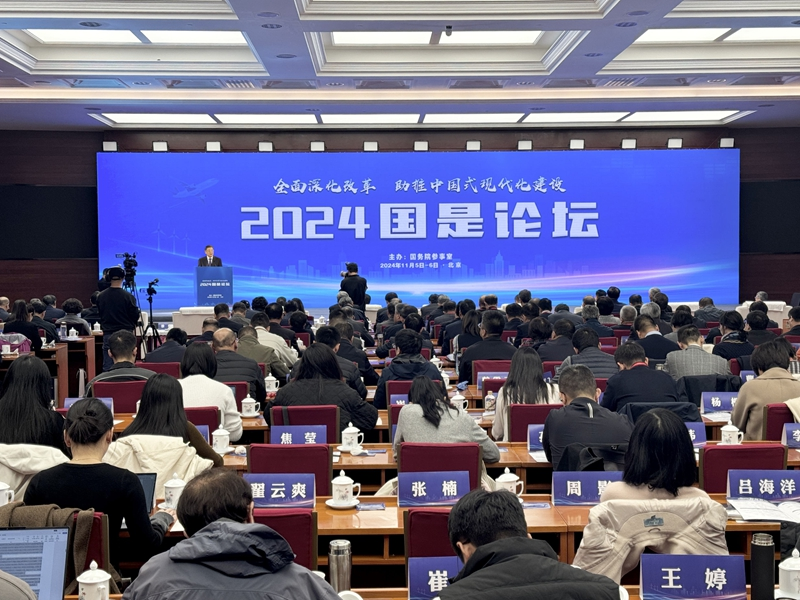
The 2024 State Affairs Forum, hosted by the Counsellors’ Office of the State Council (COSC) under the theme of “Comprehensively Deepening Reform to Advance the Chinese Path to Modernization”, was held in Beijing from November 5 to 6. Gao Yu, Secretary of the Party Leadership Group and Chairman of the COSC, attended the opening ceremony and delivered an address. Wang Hui, Member of the Party Leadership Group and Vice Minister of the Ministry of Housing and Urban-Rural Development; Shen Hongbing, Vice Minister and Member of the Party Leadership Group of the National Health Commission, and Administrator and Secretary of the Party Leadership Group of the National Disease Control and Prevention Administration;Bai Qingyuan, Vice Minister of the State Administration for Market Regulation (SAMR);and Xiao Weiming, Deputy Secretary-General of the National Development and Reform Commission (NDRC), also attended the opening ceremony and delivered keynote speeches. Xu Chang, Member of the Party Leadership Group and Vice Chairman of the COSC, presided over the opening ceremony and the keynote speech session.
In his address, Gao noted that the Third Plenary Session of the 20th CPC Central Committee has made systematic plans for further deepening reform in a comprehensive way to advance the Chinese path to modernization, charting the course forward for us. He emphasized the need to acquire a deep understanding of the guiding principles laid down at the Third Plenary Session of the 20th CPC Central Committee, uphold fundamental principles and break new ground, and firmly keep to the correct direction of reform. We must adapt to the new trends of the times, meet the new requirements arising in practice, and live up to the new expectations of the people, so as to comprehensively coordinate all efforts for advancing reform in all areas. He stressed that counsellors must focus on the central tasks and serve the overall interests of the country, and act with courage and a strong sense of responsibility. They should focus closely on the major policy decisions and reform measures set forth at the Third Plenary Session of the 20th CPC Central Committee, and present policy proposals that are targeted, forward-looking, strategic, and actionable. They should strengthen follow-up and performance evaluation of the implementation of various policies and measures, keeping a close eye on areas most directly affecting the people’s vital interests, such as people’s livelihood and public welfare. They should also make friends across all sectors and build broad consensus, pooling mighty forces to drive development.
Vice Minister Wang observed that, judging from international experience and domestic realities, China’s urban development has entered an important period of urban renewal. The Ministry of Housing and Urban-Rural Development will conscientiously implement the plans laid down at the Third Plenary Session of the 20th CPC Central Committee, and move faster to establish a sustainable model for urban renewal. In terms of philosophy, it would follow the principle that cities should be built by the people and for the people, act in accordance with scientific laws and objective realities, and do everything it can within reasonable limits. In terms of mechanisms, the ministry will improve a demand-oriented, project-led urban renewal mechanism. It will establish an integrated working mechanism linking city health examination with urban renewal, build a coordinated mechanism for financial, fiscal, tax, and land-related supportive policies, and put in place a whole-life-cycle safety management mechanism for housing. In terms of action, with the goal of enabling the people to live in quality housing that is green, low-carbon, smart, and safe, it would systematically advance the initiative for building good housing, good residential communities, good neighborhoods, and good urban districts—to build cities that are livable, resilient, and smart.
Vice Minister Shen stated that the National Health Commission has always adhered to a problem-oriented and goal-oriented approach, focusing on the challenges and difficulties in China’s medical and healthcare reform. Staying focused on the goal of basically realizing socialist modernization and becoming a global leader in health by 2035, the commission will go all out to ensure the solid implementation of all work measures. Specifically, it will first strengthen the Party’s leadership over health and wellness work, second, implement the health-first strategy, third, promote the coordinated development and governance of medical services, medical insurance, and pharmaceuticals, fourth, deepen the reform of public hospitals to see that they better serve the public interest, fifth, accelerate the building of a tiered diagnosis and treatment system with a focus on the primary level, sixth, improve the public health system, seventh, improve the systems for supporting population development and providing related services, eighth, promote innovation in medical science and technology, and ninth, improve the mechanisms for carrying forward and innovating traditional Chinese medicine.
Vice Minister Bai Qingyuan stated that to implement the guiding principles of the Third Plenary Session of the 20th CPC Central Committee, we must gain a deep understanding of the great achievements, the theme, the major principles, the major measures, and the fundamental guarantee of comprehensively deepening reform since the beginning of the new era. We must strengthen our confidence in the path of continuously advancing reform and opening up, augment our historical initiative in opening up broad prospects for the Chinese path to modernization through reform and opening up, and have the courage to undertake the mission of breaking new ground in reform and development. On the new journey of reform, the SAMR will conscientiously implement the decisions and plans of the CPC Central Committee and the State Council, apply systems thinking, leverage reform to boost efficiency and ensure unimpeded market circulation; to safeguard fairness and shore up the foundation for fair competition in the unified national market; to increase vitality and tap the potential of the super-sized market; to stabilize order and deepen the comprehensive market order governance; to promote development and improve the quality of market entities; and to strengthen safety and enhance the safety risk management.
Deputy Secretary-General Xiao pointed out that we must gain a deep understanding of the guiding principles of the Third Plenary Session of the 20th CPC Central Committee, and fully recognize the necessity of regarding economic structural reform as the spearhead to further deepen reform in a comprehensive manner. We must accurately assess the current economic situation: the fundamentals of China’s economy remain unchanged, and the economy is generally stable and improving. The NDRC will focus closely on implementing the systematic plans for economic structural reform laid down at the Third Plenary Session of the 20th CPC Central Committee. Targeting prominent issues in economic and social development, the commission will focus on six areas: promoting the common development of economic entities under all forms of ownership; working to build a high-standard market system; making macro-regulation more effective and government governance more efficient; stepping up support for all-round innovation; improving the people’s wellbeing through development; and promoting reform and development through greater openness. By taking a balanced approach, combining long-term and near-term measures, and ensuring effective implementation, we will write a new chapter in Chinese path to modernization with a proactive and enterprising spirit.
The fundamental driving force for advancing the Chinese path to modernization lies in deepening reform in a comprehensive way. Reform and opening up is an ongoing endeavor with no finishing line. This year’s forum featured seven thematic sessions: “Advancing the Reform of the Financial System,” “Improving the Institutions and Mechanisms for Developing New Quality Productive Forces,” “Improving the Institutions and Mechanisms for Integrated Urban and Rural Development,” “Prioritizing Ecological Conservation and Promoting Harmonious Coexistence,” “Deepening the Reform of the Medical and Healthcare System,” “Improving the Law-Based Business Environment,” and “Building a New Paradigm of High-Standard Opening Up.” Through dialogue, the forum forged broad consensus on reform and generated practical policy proposals, contributing wisdom and strength to further deepening reform comprehensively and advancing the Chinese path to modernization.
The State Affairs Forum, an annual thematic forum hosted by the COSC, has been held seven times since 2015. This year’s forum drew over 300 participants, including officials from relevant departments of the State Council, Counsellors of the State Council, special research fellows of the COSC, counsellors from local governments, experts and scholars, entrepreneurs, and journalists.