2023 China-U.S. Public Diplomacy Summit Held in Beijing
On December 12, the 2023 China-U.S. Public Diplomacy Summit was held at Renmin University of China (RUC) under the theme of “Future of Humankind and Global Development: Responsibilities of China and U.S.” The event brought together over 40 renowned experts, scholars, former senior officials, and representatives from political, academic, think tank, media, and business circles across the globe for in-depth discussions on important topics, including “China-U.S. Public Diplomacy and People-to-People Exchanges: Experience, Challenges, and Solutions” and “China-U.S. Relations and Global Economic Recovery: Challenges and Opportunities.” The Summit was co-hosted by Renmin University of China (RUC), China Public Diplomacy Association (CPDA), and China Daily, and was co-organized by National Academy of Development and Strategy (NADS) and New Era International Communication Research Institute, RUC.
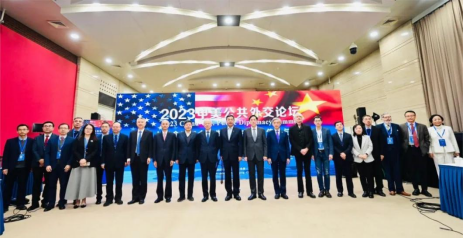
The opening ceremony featured addresses by Mr. Zhang Donggang, Secretary of the CPC RUC Committee and President of NADS, RUC, Mr. Luo Linquan, Vice President of CPDA, Mr. Sun Shangwu, Deputy Editor-in-Chief of China Daily, and Mr. Fan Yun, Deputy Editor-in-Chief of China Media Group (CMG).
Wang Yi, Vice President of RUC, presided over the opening address session.
Mr. Zhang noted that China and the United States share extensive common interests. Cooperation and competition between the two countries not only concern their own interests but also bear significant responsibility for global and regional peace, stability, and prosperity. The hope of China-U.S. relations, he emphasized, lay in the people, the foundation in non-governmental exchanges, the future in the youth, and the vitality in subnational cooperation. He called on both countries to act on the “Five Pillars” supporting the “San Francisco Vision” — namely, establishing correct perceptions, jointly managing differences effectively, promoting mutually beneficial cooperation, sharing the responsibilities of major countries, and enhancing people-to-people exchanges — and pool the strengths of the youth, the people, and progressive forces. First, education should be leveraged to solidify the foundation of China-U.S. relations by integrating high-quality “bringing in” and “going global” initiatives to train innovative talents with a global vision. Second, education should be harnessed to enhance the vitality of China-U.S. exchanges through practical cooperation in scientific research, scholar exchanges, and student programs. Third, education should be utilized to shape the future of China-U.S. relations by establishing diverse channels for public diplomacy and people-to-people exchanges, injecting strong impetus into the development of both countries through high-quality academic achievements and policy recommendations.
Mr. Luo stated that China and the United States should further strengthen people-to-people exchanges and jointly explore a pathway for peaceful coexistence and win-win cooperation. The two sides should enhance collaboration in areas such as scientific research and technological innovation to address global challenges and contribute wisdom and strength to the progress of human society, develop diversified tourism programs to encourage more people to travel abroad and deepen mutual understanding and friendship, and focus on the younger generation to cultivate more youth leaders who understand each other, laying a foundation for future friendly cooperation. No matter how the situation evolves, the historical logic of peaceful coexistence between China and the United States will remain unchanged; the fundamental aspiration of the two peoples for exchanges and cooperation will remain unchanged; and the universal expectation of people around the world for the stable development of China-U.S. relations will remain unchanged.
Deputy Editor-in-Chief Sun noted that the meeting between Chinese and U.S. Presidents has charted the course for bilateral relations in the new era, creating a forward-looking “San Francisco Vision”. He called for joint efforts to act on the consensus reached at the summit meeting in the following three dimensions. First, tell heartwarming stories of friendly exchanges between the two peoples, uncovering heartwarming and touching examples that transcend differences in systems, cultures, and languages. Second, spread the main theme of win-win cooperation between China and the United States. Major-country competition is not the defining feature of our times, and the success of each country represents an opportunity for the other, and media agencies of both nations should continue the historical narrative of China-U.S. win-win cooperation. Third, build a broad platform for dialogue and exchanges among various sectors of both countries, resolving differences and building consensus through face-to-face dialogue and heart-to-heart communication, thereby bridging the “cognitive deficit” and “trust deficit” between China and the United States.
Mr. Fan stated that China’s “media public diplomacy” can only thrive by aligning with the global trends of openness and inclusiveness, joint contribution and shared benefits, and win-win cooperation. Giving full play to the role of media in public diplomacy can effectively promote state-to-state exchanges and enhance people-to-people bonds. First, we should advance people-to-people exchanges to lay a stronger emotional foundation for China-U.S. relations. Second, we should boost extensive media cooperation to span broader bridges of understanding and communication between China and the United States. Chinese and American media should shed their ideological prejudices, tackle the development deficit, and safeguard the common well-being of humanity. Third, we should encourage interaction between think tanks and the press to facilitate intellectual exchanges between China and the United States. Media should provide richer materials and more diverse dialogue platforms for think tank research, promote the integration of theory and practice, and contribute wisdom to the peace and development of humanity.
Keynote Speeches
Keynote speeches were delivered by Ms. Armida Salsiah Alisjahbana, Under-Secretary-General of the United Nations, Mr. Cui Tiankai, former Vice Minister of Foreign Affairs and former Chinese Ambassador to the U.S., Mr. John L. Thornton, Co-Chair of the Board of Trustees of the Asia Society and Chair Emeritus of the Brookings Institution, Mr. Zhu Guangyao, former Vice Minister of Finance, Mr. Mark S. Wrighton, Chancellor Emeritus of Washington University in St. Louis, Mr. Stephen Lakis, President of the State Legislative Leaders Foundation, Mr. Xue Lan, Dean of Schwarzman College and Distinguished Professor of Arts, Humanities and Social Sciences at Tsinghua University, and Mr. Robert M. Hertzberg, former Majority Leader of the California State Senate. The session was chaired by Mr. Lin Chen, Executive Dean of the NADS, RUC.
Ms. Alisjahbana stated that, in the face of increasingly frequent and intense extreme weather events, countries around the world must accelerate the fulfillment of their national net-zero commitments, develop new low-carbon economies, and expedite the deployment of renewable energy and low-carbon technologies. Meanwhile, she called for promoting nature-based solutions through regional and international cooperation and stepping up investment in and developing carbon-neutral strategies. She emphasized that China’s valuable experience and resources in this regard should be shared with the world to help other countries achieve their net-zero targets.
Mr. Cui pointed out that the “San Francisco Vision” has injected long-awaited stability and certainty into China-U.S. relations and the global situation. The history of China-U.S. relations, he noted, has proven that a successful summit meeting should mark a new start for the sound and stable development of bilateral relations, and we should translate the vision into policy, implement it in action, and bring benefits to the people. To realize the “San Francisco Vision,” he argued, it is essential to honor commitments regarding the most important, sensitive, and potentially explosive issues in China-U.S. relations. Consensus must be put into practice, principled consensus should be upheld in addressing specific issues and be followed in driving the effective operation of dialogue mechanisms, all of which will help the vision resonate more deeply in both countries and gain broader public recognition, support, and participation.
Mr. Thornton stated that rivalry between China and the United States is counterproductive; global problems would be solved faster and better if both sides work together. He called for both sides to engage in discussions around a “vision for the future,” reach consensus on the direction of world development, and approach each other with humility, curiosity, understanding, and respect to promote deeper face-to-face meetings. Meanwhile, dialogue should be conducted in a language that the other side can understand, so as to build mutual recognition through “mutual benefit.”
Mr. Zhu noted that the stability of China-U.S. relations hinges on the strategic guidance of the heads of state. He suggested that strategic communications between the two presidents should be institutionalized to ensure that their consensus is fully and faithfully implemented. Preparations for strategic meetings between the two presidents should be made through continuous, all-dimensional policy communication. Corresponding working mechanisms should be established, expanded, and consolidated. He also urged China and the United States to reach an agreement on artificial intelligence cooperation within 5 to 10 years, shouldering responsibility for safeguarding the well-being of both peoples and maintaining world peace and development.
Mr. Wrighton noted that current global challenges know no borders and no country is too small to be affected; no single institution or even a single country can tackle these issues alone. He called for China and the United States to maintain collaboration, with “reciprocity” as their common goal, joining hands to address challenges and bring benefits to the world. He also observed that China’s research universities have made tremendous progress and expressed hope that academic exchanges and cooperation between Chinese and American institutions could promote the sound development of China-U.S. relations.
Mr. Lakis believed that China is an important Asian partner of the State Legislative Leaders Foundation, and that exchanges between legislative leaders of the two countries have effectively promoted cooperation between the two sides and yielded remarkable historical achievements. Looking ahead, he said, the two major powers should pursue deeper cooperation on topics such as energy, the environment, and climate change, helping countries around the world jointly address the negative impacts of these challenges.
Mr. Xue argued that the perceptions of China among the public in the United States are unlikely to improve in the short term. He pointed out that various restrictions imposed by the U.S. government on China-U.S. scientific and educational exchanges have intensified the “chilling effect” on bilateral research cooperation. The deterioration of China-U.S. relations, he warned, would lead to worsening relations between China and the West, which would in turn further deteriorate China-U.S. relations. Therefore, he called for insulating the infrastructure of bilateral cultural, scientific, and technological exchanges from political tensions, establishing more robust institutional frameworks, ensuring the normal implementation of educational and cultural exchange programs, restoring normal media relations between the two countries, strengthening cooperation, enhancing mutual trust, and rebuilding pluralistic channels of communication.
Mr. Hertzberg stated that Chinese and American civilizations should draw on each other’s strengths and make progress hand in hand. Chinese culture, history, and experience are highly valuable and worthy of study and emulation by the United States. Despite difficulties, both nations must devote profuse enthusiasm and adequate vigor to their bilateral relations. He stressed that, in its future foreign policies, the U.S. must attach greater importance to China, uphold the fundamentals of China-U.S. relations, consolidate the foundation of friendship between the two peoples, and rise to the challenges of history hand in hand.
Panel Discussion I: China-U.S. Public Diplomacy and People-to-People Exchanges: Experience, Challenges, and Solutions
Panel Discussion I was moderated by Ms. Wang Lili, Deputy Dean of NADS and Professor at the School of Journalism and Communication, RUC, as well as the Chief Planner and Lead Moderator of the Summit. Panelists included Mr. Colin Bradford, Senior Fellow at the Brookings Institution and Co-Chair of the China-West Dialogue, Mr. Wang Fan, President of China Foreign Affairs University, Mr. Peter C. Perdue, Professor at Yale University and member of the American Academy of Arts and Sciences, Mr. Zhou Yong, Dean of the School of Journalism and Communication, RUC, Mr. Xing Zhigang, Member of the Editorial Committee and Director of the Editorial Department at China Daily, Mr. John Milligan-Whyte, Chairman of the America-China Partnership Foundation, Mr. Jia Qingguo, Member of the Standing Committee of the National Committee of the Chinese People’s Political Consultative Conference and Director of the Institute for Global Cooperation and Understanding, Peking University, Mr. Zhou Qing’an, Dean of the School of Journalism and Communication, Tsinghua University, Mr. George S. Geh, Chief Executive Officer of China Institute in America, Mr. Laurence Brahm, Founding Director of the Himalayan Consensus Institute, and Mr. Xiang Debao, Director of the Center for International Public Opinion and Global Governance at Beijing Foreign Studies University.
Ms. Wang noted that following the global pandemic and a period of downturn in China-U.S. relations, bilateral ties began to gradually show signs of warming in the first half of this year. The summit meeting between the two heads of state in San Francisco in mid-November created a “San Francisco Vision” oriented toward the future, charting the course for the sound development of China-U.S. relations and bringing stability and confidence to a turbulent world. To better advance China-U.S. public diplomacy, she said, we need to review history, explore historical lessons, examine current challenges, and identify pathways forward, with a view to strengthening mutual understanding and promoting consensus between China and the United States.
Mr. Bradford maintained that people-to-people exchanges are vital for understanding perspectives from different cultures. Overseas living experience enables people to realize how individuals in different countries view the world in different ways. This awareness of cultural differences should be integrated into the broader framework of China-U.S. relations, and culture should be more fully incorporated into public diplomacy, geopolitical dialogue, and policy negotiations. He argued that pluralism is a core component of international relations and advocated for greater exchanges on culture and civilization by leveraging the G20 platform to drive positive geopolitical changes.
Mr. Wang pointed out that China-U.S. relations are currently in a historical transition period characterized by “structural tensions in major-country relations.” He argued that both sides should proceed from shared interests rather than pursuing zero-sum gains at the other’s expense. The common threats facing China and the United States outweigh the threats they pose to each other. The two sides should move beyond mutual antagonism and join hands to address common challenges. The development of China-U.S. relations must be based on reciprocity and mutual benefit, protecting each other’s investments and interests without weaponizing the outcomes of cooperation.
Mr. Perdue viewed issues of China-U.S. public diplomacy as an integral part of international politics, contending that government policies in both countries are significantly shaped by public diplomacy. He noted that there have been many memorable historical moments in China-U.S. relations, and that the personal charm of diplomats or the deep resonance of cultural exchanges can significantly transform public relations between the two countries. He also emphasized that the most important principle in public diplomacy is sincerity, which can effectively promote government-to-government diplomacy.
Mr. Zhou observed that current international communication practices have increasingly deviated from their original intention of mutual learning and exchange. Market mechanisms risk exacerbating inequalities in international communication, marginalizing the voices of small countries and non-mainstream media. Meanwhile, spontaneous order may bring about challenges regarding diversity and fairness, exhibiting inherent limitations when dealing with diversity in international communication. Therefore, it has become both necessary and feasible to build a more equitable and mutually beneficial new order for international communication by drawing on new practices and concepts from various countries including the Chinese path to modernization.
Mr. Xing stated that although the risks of decoupling and severing supply chains between China and the United States have spilled over to the fields of media and people-to-people exchanges in recent years, the reality that the interests of the two countries are closely intertwined has not changed. While the two countries have different systems and cultures, this does not mean that they are destined to embark on a path of civilizational conflict. He called for both sides to increase the sharing and exchange of ideas, so as to eliminate deficits in understanding, perception, and trust through equal-footing dialogue and promote the steady and long-term development of China-U.S. relations.
Mr. Milligan-Whyte argued that the old school of thought on China-U.S. relations sought to have China accept American core interests while disregarding China’s own interests. In contrast, the new school emphasizes mutual benefit and peaceful coexistence in the new era of China-U.S. relations, facilitating consensus on economic growth and national security. In the event of the next global financial crisis, the new school aims to provide a comprehensive agreement for both China and the United States to avert military conflict and resolve problems that the traditional model has proven incapable of addressing.
Mr. Jia pointed out that since the 1970s, people-to-people exchanges between China and the United States have grown increasingly robust, serving as an important pillar of bilateral relations. However, in recent years, there has been inadequate appreciation of the importance of such exchanges, along with potentially excessive security precautions and ambiguous laws and policies. Therefore, he called for enhancing mutual understanding between China and the United States on economic development and peaceful coexistence, adopting appropriate security precautions, clarifying implementation details of laws and policies, and alleviating issues such as difficulties in visa applications and high flight fares.
Mr. Zhou noted that the media play an important role in reshaping public perceptions of each other, but their role in public diplomacy has been underestimated. Currently, in public diplomacy, the media are used more for problem-solving than for consensus-building. Therefore, China and the United States need to explore new areas of media narrative on the basis of mutual trust. Against the backdrop of structural adjustments in globalization, future narratives of China-U.S. relations will be based more on a risk society, and both sides should emphasize common challenges and risk awareness to lay the foundation for bilateral cooperation.
Mr. Geh noted that China Institute in America was founded in 1926 to promote American community’s interest in Chinese culture and help Chinese students in the United States. The Institute has long been committed to promoting people-to-people exchanges between China and the United States, advancing cultural education, offering Chinese culture courses for Chinese students in the United States, and organizing art exhibitions. Despite challenges facing China-U.S. relations, he expressed confidence that greater progress will surely be made if the world’s two largest economies work together.
Mr. Brahm emphasized that communication and dialogue are crucial for mutual understanding between the two sides. He cited the film Searching for Kung Fu produced by China Daily as an example—not about competition, but about exploring shared values. Kung Fu films are beloved by Americans precisely because they embody shared values of justice and fairness. Although Chinese and American values differ, there is still much consensus in many areas. He suggested that all countries could learn from China’s doctrine of the mean, seeking harmony between yin and yang.
Mr. Xiang argued that in the social media era, American “China hands” have formed a tight-knit network for China-related public opinion, playing a key role in information flow, building a research community, shaping American perceptions of China, and influencing China-U.S. relations. Therefore, strengthening exchanges between high-end think tanks and experts from China and the United States, and cultivating a new generation of American “China hands”, is crucial for the development of bilateral relations. At the same time, American “China hands” should offer rational advice and contribute to fostering a correct understanding of people-to-people exchanges between China and the United States.
Panel Discussion II: China-U.S. Relations and Global Economic Recovery: Challenges and Opportunities
Panelists in Panel Discussion II included Ms. Chen Wenling, Chief Economist at the China Center for International Economic Exchanges, Dr. Evandro Menezes de Carvalho, President of the Getulio Vargas Foundation, Mr. Liu Qiao, Dean of the Guanghua School of Management, Peking University, Mr. Hisham AbuBakr Metwally, Chief Economist of the Egyptian Ministry of Investment and Foreign Trade, Mr. Gao Bai, Professor at Duke University, Mr. Nie Jun, Dean of the Economics and Management School of Wuhan University, Mr. Robert A. Kapp, former President of the U.S.-China Business Council, and Mr. Xiao Geng, Chairman of the Hong Kong Institution for International Finance. The session was moderated by Professor Liu Qing, Deputy Dean of the NADS, RUC.
Ms. Chen argued that neither side can afford the consequences of conflict and confrontation between the two countries. She noted that nearly 3,000 trade restriction measures were imposed globally last year – almost triple the number in 2019 – which have had a severe negative impact on the world economy. Amid unprecedented global changes in a century, China and the United States need to step up cooperation. They should leverage economic and trade ties to uphold the momentum of the peaceful development of the world economy, coordinate their monetary policy to sustain global macroeconomic coordination and stability, ensure the smooth functioning of their industrial and supply chains, and renew the China-U.S. Science and Technology Cooperation Agreement.
Dr. Carvalho contended that the world has been deeply scarred by a series of events including the pandemic, climate change, and technological transformation over the past period. As the world’s two largest economies, China and the United States need to consider how to address both the imminent and long-term challenges facing human society. Urgently needed in China-U.S. relations is a new world order – one that sets aside differences and contradictions, bridges cultural divides, promotes equal exchanges grounded in common interests, fosters people-to-people dialogue, and upholds multilateralism.
Mr. Liu stated that with China and the United States currently accounting for approximately 43% of the global economy, any friction in their economic interactions would significantly constrain global economic recovery. Both countries face common agendas and challenges: specifically, how to find new drivers of economic growth, boost industrialization, and increase total factor productivity. In this context, cross-border green investment could emerge as a new opportunity. He suggested that going forward, China and the United States can identify new focal points in addressing climate change and biodiversity governance, thereby fostering a new level of economic exchanges.
Mr. Metwally argued that the United States has been playing the role of the “Hand of God” since before World War I, imposing its ideas on economics and global governance on the rest of the world. However, American society is far from united, and the views of the American people and their government are not always aligned. He noted that the Trump administration’s series of protectionist policies inflicted suffering on countries around the world, and the Biden administration did not stray from this path. Faced with this situation, the global community must join forces to tackle development challenges, including rising global inflation, increasing poverty, and frequent conflicts.
Mr. Gao argued that the unprecedented global changes in a century are the product of the convergence and resonance of three historical cycles: first, the pendulum swing of globalization beginning to move toward a phase of deglobalization; second, the hegemonic transition cycle and the resulting tensions in China-U.S. relations; and third, the technological revolution that is reshaping the balance of power in world politics and economics. The strategic interaction between a hegemonic power and an emerging one poses a significant risk of triggering war. To address this, China and the United States should return to the principle of reciprocity, expand intra-industry trade, and explore potential solutions following this important institutional framework.
Mr. Nie stated that global economic growth is jointly driven by China and the United States, the two major powers. Despite their different economic structures and cycles, the world’s two largest economies are each other’s most important trading partners. Their economic policies are closely intertwined, and the two countries have long played a role in supporting each other while jointly stabilizing the global economy. He called on the two countries to manage differences, pursue cooperation, and work together to bring the global economy back on track while respecting each other’s security concerns.
Mr. Kapp argued that cultural and youth exchanges are an important part of China-U.S. public diplomacy. He believed that, if culture is compared to a blanket, it is not feasible to cover up all contradictions inside. China needs to articulate its public relations more clearly, and the United States needs to gain a better understanding of China’s political system and social relations. The importance of public diplomacy and people-to-people exchanges calls for more interaction across different channels, pooling incremental efforts to prevent potential confrontation before it escalates into a spiral of conflict.
Chairman Xiao of the Hong Kong Institution for International Finance noted that Hong Kong is currently facing constraints on its economic development due to international geopolitics and a range of China-U.S. policy factors. Owing to differences in political systems, the United States is able to achieve short-term economic growth goals but often overlooks many medium- and long-term challenges, while China has made remarkable progress on the Belt and Road Initiative, climate change, and common prosperity. He therefore argued that both countries need to learn from each other regarding macroeconomic policies, and to reflect on cooperation and competition in the technology sector as well as on national security issues.
At the conclusion of the forum, Professor Wang, Deputy Dean of NADS, RUC; Ms. Huo Ying, Secretary-General of CPDA; and Ms. Zhu Ping, Director of the Opinion Section of the Editorial Department and Senior Editor at China Daily, delivered closing remarks on behalf of the three co-hosting organizations.
Ms. Zhu stated that this year’s summit fully leveraged the think tank strengths of RUC, the bridging role of CPDA, and the international outreach of China Daily, creating a new model of trilateral cooperation for mutual benefit and making meaningful contributions to exploring exchanges and cooperation between China and the United States. She noted that the forum offered both macro analysis of political, economic, and people-to-people dynamics, as well as micro, three-dimensional communication case studies. In addition to Chinese and American guests, the summit also invited experts from Brazil and economists from Egypt, offering a fresh third-party perspective for understanding China-U.S. relations.
Ms. Huo argued that China and the United States should work toward a shared, accurate understanding of each other, approaching China-U.S. relations from a broad perspective and with a long-term strategic view. Both sides should encourage and expand friendly exchanges between their peoples, continue to broaden channels for exchange at the local, think tank, media, youth, and other social levels, and firmly strengthen the social and public foundation of China-U.S. friendship. At the same time, China and the United States should work together to enlarge the “pie” of cooperation, and restore or establish mechanisms for cooperative dialogue in various fields to provide more public goods to the world.
Prof. Wang stated that the China-U.S. Public Diplomacy Summit, founded in 2015, has spanned eight years and witnessed the ups and downs of China-U.S. relations. In today’s world, human society is accelerating into a new historical cycle. She expressed hope that the summit will promote mutual understanding between China and the world at large, and between China and the United States in particular, foster rational listening, exchanges, and dialogue between China and the United States, and ultimately advance the future of humanity and global peace and prosperity. (Contributed by the NADS, RUC)